
Note: This is the Durango in Mexico. To read about Durango, Colorado, USA, click here.
Why Durango:
I had a free weekend in mid-February and wanted to take a last-minute trip. Domestic airfares in mid-February were crazy so I looked at taking a weekend trip in Mexico from the Tijuana Airport (my favorite hack). I ended up finding great deal to Durango – one of the most remote and least visited states in the country. Durango is also a relative island of safety in a dangerous part of the country. Seems interesting!
With the cheap flights came unfortunate flight timing. My options were a 2:00 or 6:00 flight on Saturday morning and a 7:00 return flight Monday morning. This worked perfectly with the weekend schedule but was going to be brutal.
February 14, 2026: The City Center
I spent Friday night in my friend Marty’s apartment in downtown San Diego and woke up at 3:30 AM. After driving to the Cross Border Xpress (a unique setup where you park your car in the US and then enter by a special border crossing directly into the Tijuana airport), I reached Mexican immigration at 4:30. However, the immigration line was over an hour long– a first since every other time I have breezed through. This was likely due to the vacation crowds for the President’s Day week. Luckily security was easy and I got to the gate 25 minutes until departure. We departed on-time at 6:00 and I immediately fell asleep.
The flight to Durango took two hours. The landing was bumpy due to strange wind patterns, but we landed safely.
I rented the car (completely in Spanish) and then drove into the city.
My first stop was an early lunch. Durango’s most famous food is probably the gordita. Based on online research, I found Gorditas La Oberta. Immediately I noticed the line stretching to the door. This place was going to be good.

A gordita is essentially a corn pita filled with various stews and toppings – although in Durango they are made with flour. And there are a lot of options. I did not know how to order but just asked to do whatever the previous customer did. I got one with spicy red pork and another with cactus. Once the toppings are put into the gordita, they are cooked on a stovetop. They were delicious but very spicy.

A few blocks from the gordita place was a beautiful convention center containing stone murals depicting the history of Durango. The city was founded by Spanish explorer Francisco de Ibarra in 1563. He named the city after his hometown Durango in the Basque Country. The city was founded to mine a nearby mountain which was thought to contain silver but actually contained iron. The iron made the city extremely wealthy and is the reason for the gorgeous historic core. The city was also a key part of the Camino Real de Tierra Adentro (Royal Way of the Interior Land) – a road that connected Mexico City to Santa Fe in New Mexico, United States. In the 1900’s, Durango’s economy shifted to becoming a major filming location for Western– both Mexican and American. In 2010, the Camino Real de Tierra Adentro including the city of Durango became a UNESCO World Heritage Site.
With that all in mind, it was time to head into the center to start exploring. My hotel was right in the center. After parking my car, it was time to go.
One block south of my hotel was the Museo Francisco Villa. Francisco Villa, better known as Pancho Villa, was a key figure in the Mexican Revolution which occurred in the 19-teens.

The history is really complex with many different stages, but to keep it short, Villa helped oust multiple presidents during the war. He briefly Governor of Chihuahua and President of Mexico. After being defeated by his rival Obregon with help from the US, he then led a raid to attack the town of Columbus, New Mexico and possibly a few other border cities. The raid on Columbus was the first attack on US soil since the War of 1812. Villa was never captured. Eventually he made a deal to retire to a hacienda in Chihuahua state but was assassinated just three years later.

Today, Villa is considered almost a folk hero in Mexico and the southwestern US. He is known for his banditry, military leadership, his willingness to successfully stand up to the US, and his womanizing. But the legacy is not all positive: he is seen as unnecessarily destructive and brutal and was not a successful politician.

The museum itself was run by the federal government and is in a mural-filled grand palace that formerly housed the state government. The museum exists here in Durango because Villa was born in Durango state. Almost all the exhibits were in Spanish but the former governor’s office and film section had English content.


For an additional 40 pesos (just over $2), I was able to gain entry to four additional museums run by the federal government.
This included an archeological museum which had purposefully-elongated Mesoamerican human skulls!

It also included a lackluster art museum, a folk-art museum, and a coin museum.

I then went to the central market. Durango’s symbol is the scorpion, as the animal lives in the surrounding desert. Most shops had something scorpion related whether it was a t-shirt, a mezcal bottle with a scorpion suspended inside, plates with scorpions or even lollipops with a suspended scorpion.


I next visited the Museo de la Ciudad 450- a municipal museum showcasing the city’s 450-year history. The exhibits were in both Spanish and English. However, the museum director was so excited to see a foreign tourist that he appointed a teenage intern who could speak English to give me a private tour around the museum. In exchange, I posed for photos around the museum that will be used for their website and social media.
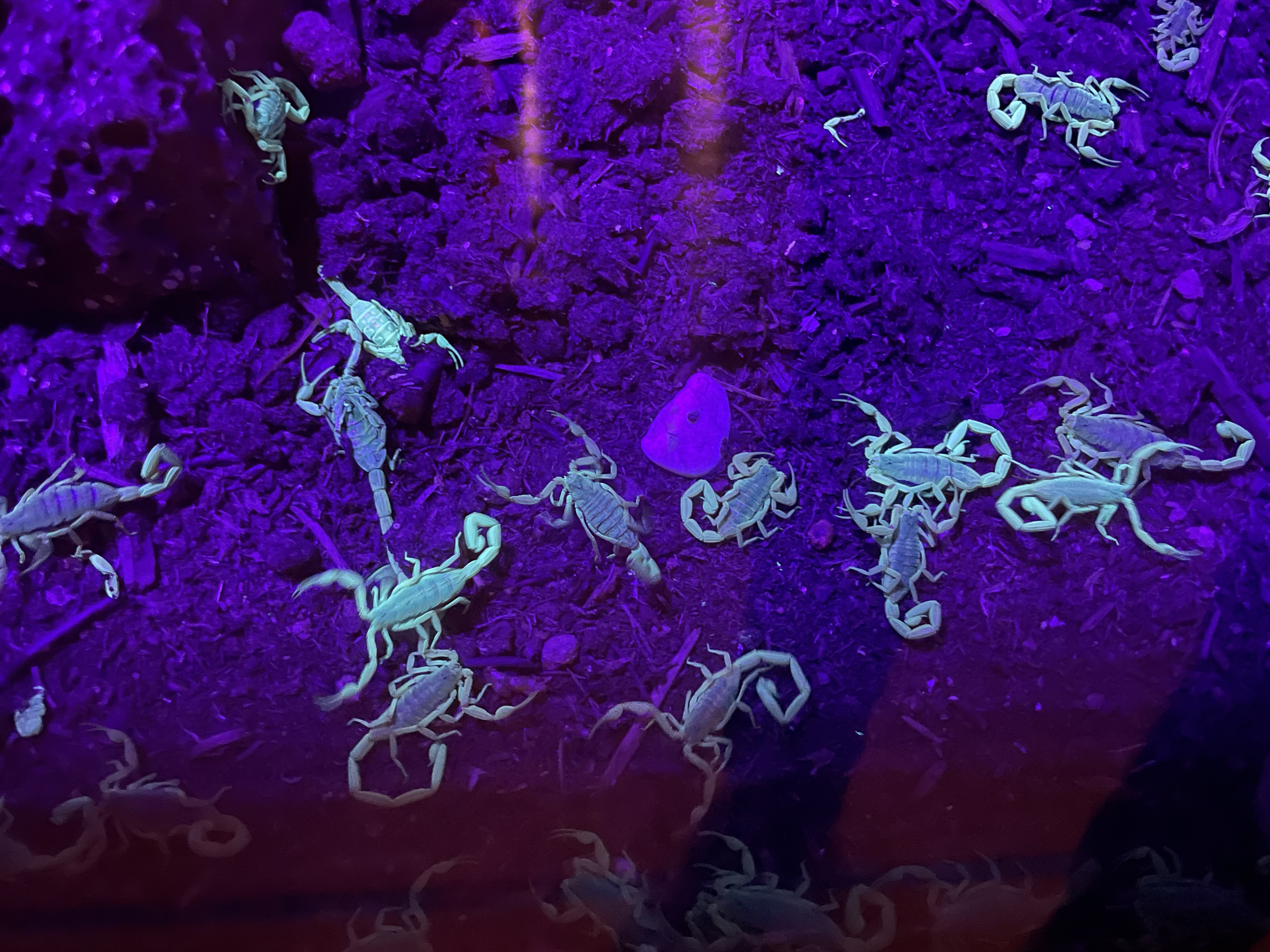
Highlights of the museum included a terrarium of glow in the dark scorpions. Some impressive murals in a room currently used as the city council chambers and many film artifacts. This was the best museum I visited during the day.
For my final museum, I went to the Museo Regional, which is run by the state government. Housed in an old mansion.

By this point, I had seen almost every museum in Durango (there are so many) and the sun was starting to set. I went for a walk along the pedestrian street which was all decorated for Valentine’s Day. The city was so lively.

For dinner I got a steak and then quickly went to bed.
February 15, 2026: Outside the City
Having seen the main sights in the center, I then got into my rental car and drove to see the sights nearby.
There are two main areas to go: west and southeast. I opted to go to the southeast because it felt more “Durango”.
Along the way, I stopped by a church built in 1563 and stuck in time.

The town of Nombre de Dios was founded in 1562 – also by Francisco Ibarra but a year before Durango. It is the oldest town in northern Mexico. While the town is historic, not much remains from 1562 so it really looks like any other town.
Nombre de Dios is best known today for mezcal. The town’s sign even says “Bienvenidos A Nombre De Dios. Tierra Del Mestizaje Y Del Buen Mezcal” (Welcome to Nombre de Dios. Land of mixed races and good mezcal). The town square is full of mezcal vendors and mezcal production facilities/distributors.

Since it was only 10:00 and too early to drink mezcal, I instead got breakfast at a 70-year-old gordita shop called Doña Aleja. The place exuded charm and the gorditas were amazing. Luckily this place had an actual menu so I was able to understand what I was ordering.

With nothing else to do in the town, I headed west towards an unexpected sight: a large waterfall. In the middle of the desert!

Next, I drove through the countryside and ended up at a mezcal production facility. I took a guided tour where I ended up being the only one on the tour. The man was a third-generation mezcal maker.
Mezcal is a term for any liquor made using agave. There are about 30 species of agave that can be made into mezcal. The most popular type of mezcal is tequila which is made from the blue agave and must be produced in the state of Jalisco. Excluding tequila, mezcal is known for its smokiness. 90% of mezcal is produced in the state of Oaxaca, but there are 10 states that can legally produce mezcal under the Denomination of Origin certification. Durango’s mezcals are mostly produced from the local agave species called Cenizo (ash-gray) due to its color which only grows at high elevation. Mezcals from Durango apparently have a unique profile that is relatively less smoky and slightly fruitier than its Oaxacan cousins.
My guide then showed me how he makes mezcal but there was no production going on at the moment. While mezcal can be made in the winter, the fermentation process takes 2-3x longer so instead they choose to take the time off.
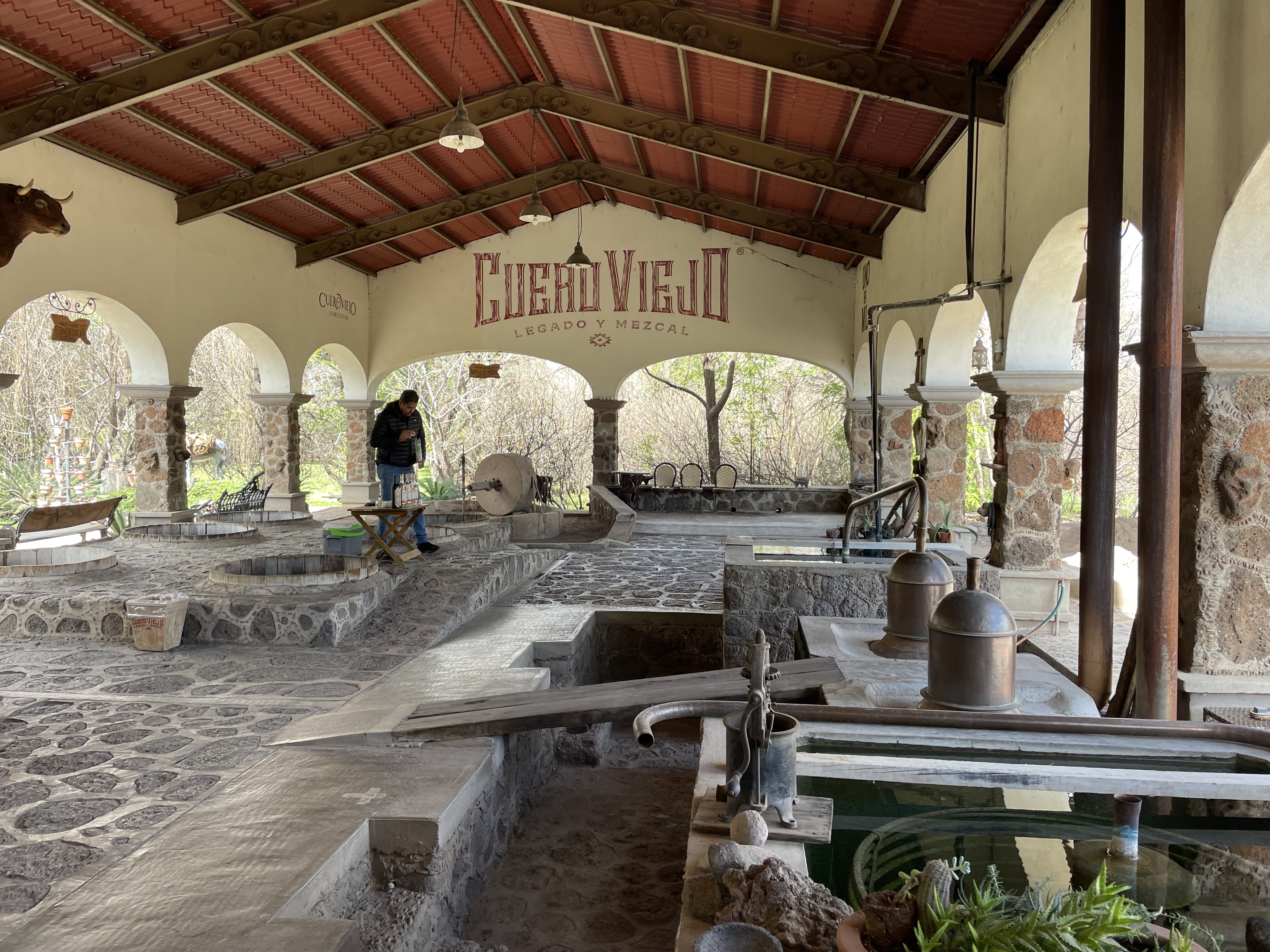
The first step in making mezcal is roasting the agave hearts in mountain of volcanic rock.
Next, the roasted agave gets crushed by a stone roller.
Then, it ferments for four days in an uncovered wooden vat.
Next, the liquor gets distilled twice to remove the impurities.
Finally, the liquor gets bottled. Mezcal then ages in the bottle. A young mezcal rests for a couple of months but some older mezcals can be aged for years. The amount of alcohol in a mezcal varies greatly. The mezcals I tried were between 38-52%.
After learning about the production process, it was time to taste the mezcal. We tried five different types. Four of the mezcals were Cenizo and one was a Lamparillo, a very rare agave species also endemic to Durango.
Before getting to taste the mezcal, I had to learn how to smell the mezcal and extract the flavors. This involved quickly moving the mezcal around my nose so I could smell the aroma without the alcohol. Lo and behold it worked – when quickly moving the shot glass around, I picked up notes of various fruits and even lemongrass from the lamparillo.

Each mezcal tasted different. With the guide, I was able to appreciate how each variable in the process affects the outcome. Very cool!
For the afternoon, I drove back to Durango and visited the Paseo del Viejo Oeste (Promenade of the Old West). This former Western film set is now an “old west” theme park. John Wayne filmed here. It looks identical to any fake old west town with English signs and country music blasting. The main difference is that everybody is Mexican and speaking Spanish. The other big difference is that political correctness towards Native Americans hasn’t quite made its way south of the border.

I arrived just in time for the twice-daily melodrama performed on the main street. The characters first paraded down the street holding sponsorship banners. Then the play began – in Spanish. There were cowboys, Indians, and even saloon girls who danced the can-can. My Spanish wasn’t good enough to understand the play but the audience laughed a lot. The melodrama lasted an hour and ended in a dramatic shootout.

All the actors then posed for photos (for a tip). I got a wild photo with a group of bandits.

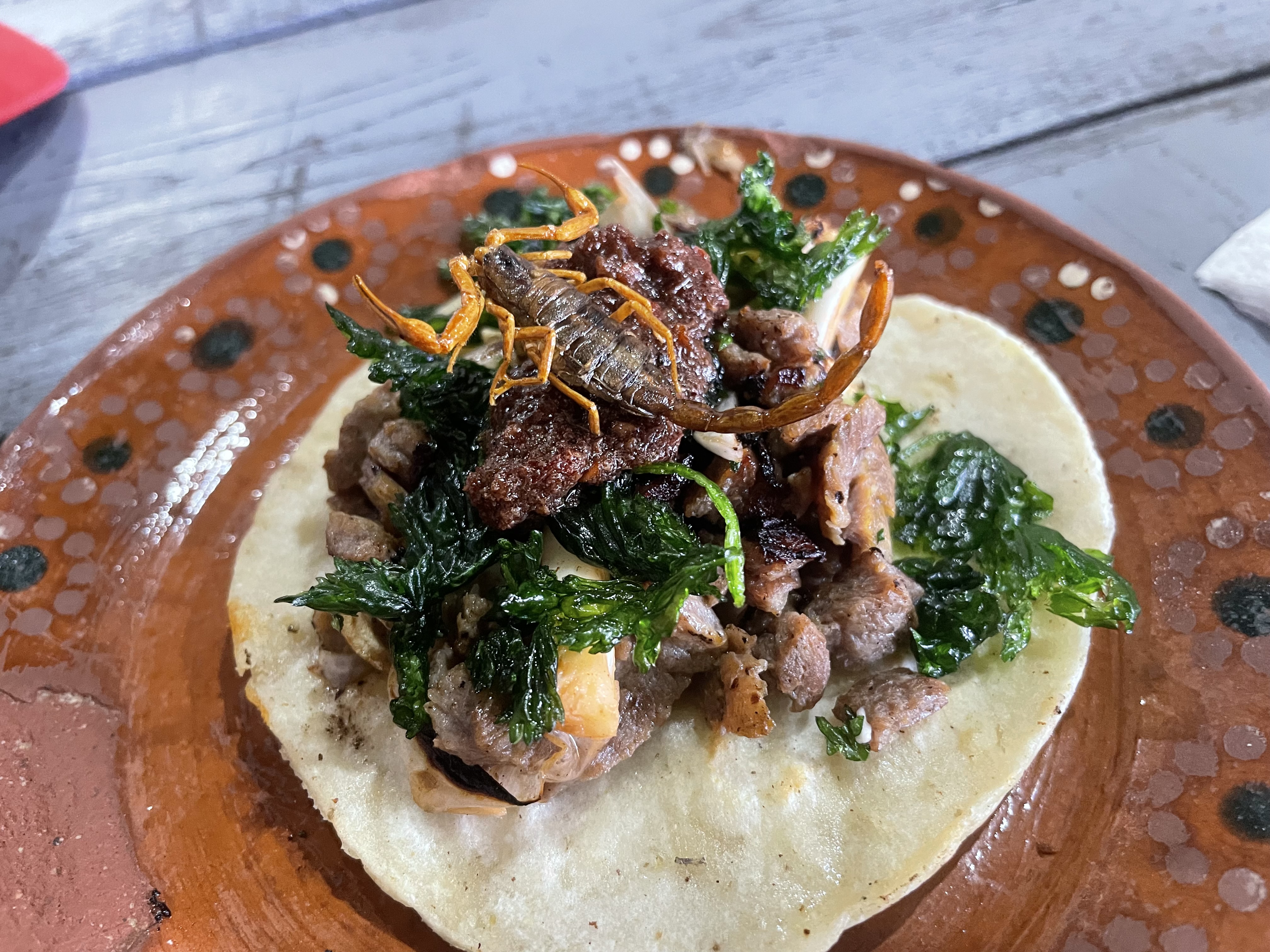
I then saw a poster advertising scorpion tacos. This seemed like an “only in Durango” thing so I went for it. The single taco was 160 pesos ($10 USD). It was a carne asada taco topped with the scorpion. The scorpion itself tasted crunchy but without too much flavor (honestly a good thing). Overall, better than expected.
I also drank a cantarito – a cocktail from Jalisco that is basically a fancier paloma served in a clay jar which keeps the drink cold.

On my way back into town, I stopped by a large public park called Parque Guadiana. It was packed with people. I discovered a sports arena and, as luck would have it, a professional volleyball game was about to start. Tickets were $6 USD – how could I not go?!
The women’s volleyball league was brand new. It was formed just a couple months ago so interest was high. The arena was mostly sold out. Durango Coronelas were playing the Puebla Guerreras. The atmosphere was electric. The public announcer kept the crowd cheering and there were crowd chants/dances for aces or a big smash. Most of the players were Mexican but Durango had one lady from the US and another from Poland.
Durango won 3-0.

I then headed back to the hotel and the town center. I finally went into the massive cathedral which was built between 1695 and 1713.

Then across the street in the Plaza de Armas, a band was playing covers of pop songs as part of a municipal Valentine’s Day celebration that was also co-sponsored by the military.

For dinner, I ate in the hotel’s restaurant. I got a caldo duranganese – a beef stew from Durango.

Then, I went to bed for my early flight. The next day I woke up at 5:00 and got to the airport for my 7:00 flight. I landed in Tijuana at 8:00 and was across the border at 8:25.
Final Thoughts:
Durango is a wildly underrated destination. It is safe, beautiful, authentically northern Mexican and there is so much to do. The city is also compact and walkable. I really can’t say enough good things about Durango. 2-3 days is the right amount of time to explore the city and the surroundings.
The one challenge is that because of the lack of tourists, it would be hard to get around without knowing Spanish. Yes, encountered a few English speakers here and there but the vast majority of people do not speak any English.
Durango is very remote. The nearest city is Zacatecas which is currently off-limits due to safety. The best city to combine it with would be the beach resort town of Mazatlan in Sinaloa. Apparently the new highway between Durango and Mazatlan is the prettiest road in all of Mexico.
If coming from the US, besides Tijuana, there are direct flights from Chicago (on Volaris) and daily from Dallas (on American).
Leave a Reply