
Why Bangui:
The Central Africa Republic (CAR) is one of the most dangerous and difficult to visit countries in the world. Nearly every country lists it on their Do Not Travel lists. For better or worse, the goal to visit every country does in fact mean visiting dangerous ones too.
In November, I received an email about an upcoming group tour to the Central African Republic run by Nomadmania, a website run for and by extreme travelers. Given their experience traveling in difficult regions, I deemed them a trustworthy source and decided that going with them would be the safest and cost-effective way to visit. The tour would take place in/around the capital of Bangui, widely considered the safest region of the country. The tour lasted just 72 hours, which meant I could visit over a long weekend.
There is one other place that people visit in the Central African Republic – a national park in the extreme southwest. However, reaching there would require either chartering an NGO’s private plane or a multi-day overland journey from Cameroon. Neither options seemed appealing.
March 28, 2025: Ni Hao
After an overnight flight to Chicago and another overnight flight to Addis Ababa, it was finally time to board my final flight: a 3-hour relative hop to Bangui.
The Addis Ababa airport had been redone since I last visited in 2018 on my way to Republic of the Congo and it looked nice! At the gate, I met most of the members of our group: a couple Americans, a British lady, a Mexican man and a Norwegian lady. Two more Norwegians would meet us in Bangui.
As Addis Ababa is a hub for travel all over the African continent, there are flights going everywhere. The Bangui flight appeared to have the highest percentage of white people of any flight – more than a third. Even more than Kilimanjaro, Malawi and Johannesburg. Most of the white people were Russian – they were speaking Russian and just had that look. One guy had an EU/Serbia jacket on which is strange because Serbia is not in the EU.

Upon landing, we were all told to remain in our seats white the plane was met by a huge delegation that appeared to include the president who was wearing a large sash with the country’s flag. I could also make out displays containing the flags of the CAR and China, which makes me think that this is a high-level Chinese trade delegation.

After deboarding and entering the airport, we were met by our guide Steve who guided us through the immigration process. First, our yellow fever vaccines were checked, then we registered with the police and then we got our passport checked and stamped. Finally, we had our bags checked where the lady had a crush on me and told Steve she wanted to meet up with me tonight. In total, it took our group 1.5 hours for group to get out, which is pretty good considering its in Africa and the number of steps.
We then drove 10 minutes to our exceedingly secure hotel. We were told that this is the nicest hotel in the entire country, it is listed as 5-star but is in reality a dated 4-star property. Due to regular power cuts, each room is equipped with a flashlight. It was built by Libyan dictator Muammar Gaddafi as part of his effort to “invest in Africa”.
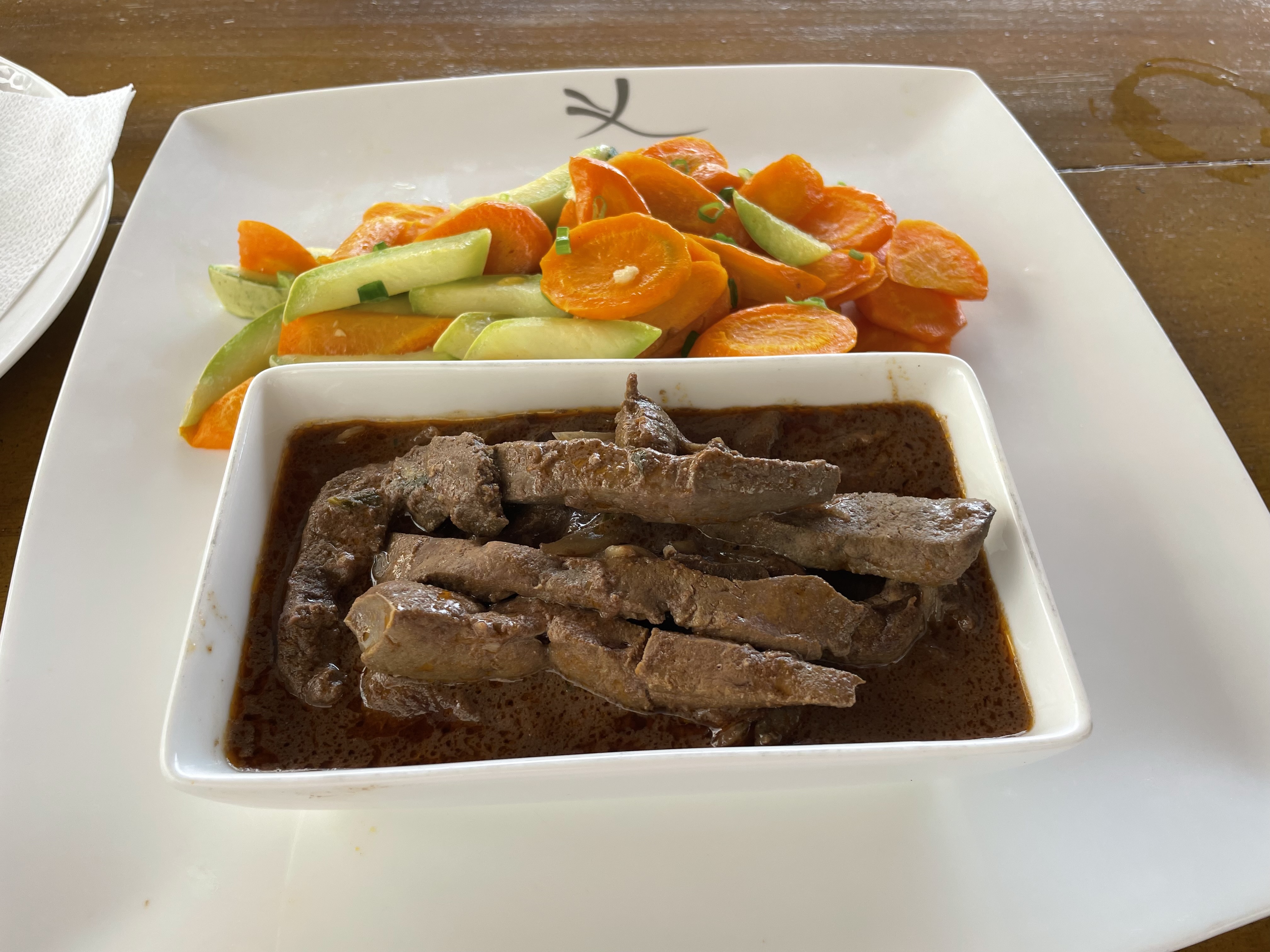
After taking a dip in the hotel pool, I ordered lunch. I thought it was beef, but it tasted funny. Turns out it was beef liver (foie). Healthy!
At 3:30, we headed out on our main activity: a boat tour of the Ubangi River, which forms the international boundary between the CAR and the Democratic Republic of the Congo. We boarded our motorized canoe near an abandoned hotel.

Life on the river seemed surprisingly quiet given we are in a national capital. We saw many abandoned boats and barges on CAR side.

The DRC side contained the small town of Zongo (Yes, it is Zongo, Congo). We saw a decent amount of canoe traffic crossing the river. I would guess that many people live in DRC and cross to CAR for work or shopping. I didn’t try but others in group attempted to pay $425 for DRC visa before trip but application was denied. Crossing the river would have been cool, but I would rather spend my time in CAR and visit the DRC for real one day.
We noticed many children swimming in the water, which was a lovely temperature! Everyone seemed to be obsessed with my Barcelona shirt – maybe 1 in 20 men was also wearing a Barcelona jersey. I wonder why they are the main team.
We disembarked at refugee camp for people who used to live on an island in the middle of the river but moved due to flooding. They lived in tents made with UN materials. Kids swarmed our boat and wanted to meet us – I get it, it’s not every day they see white people who are not soldiers. We posed for photos with the kids and then walked around to see the village life. Steve our guide bought snacks for kids from a bakery hut. The donuts looked horribly stale, but they are probably delicious due to the French baking influence.

Since I don’t take many group tours, I also enjoyed seeing how the various people on our tour acted. Some people want to tons of photos. Others want to chat with locals. Others want to chat with guide. Others want to just look silently. Obviously, I have my preferences on how people should act/what they should to do but everyone is entitled to spend their holiday as they wish. So, on the group trip, you must accept this.
Back at the hotel, we got dinner. They had a buffet but at this point in the night, everything had already been picked at, so I passed.
The Chinese contingency is also staying here. Armed security guards are everywhere including three on our floor outside the elevator banks.
Some place!
March 29, 2025: Better Than Expected
We started our day at 8:30.
Before leaving, we were given strict rules. We were not allowed to take photos around Bangui except when given explicit permission from Steve our guide. The reason is that many groups patrol the city with heavy weaponry. If you take a photo, it’s both a security risk to them but also, they may think you are attacking them. So, by taking a photo, someone may shoot at you. Like in most developing countries, you also cannot take photos of government buildings. Since basically the entire center of Bangui is government or UN or NGO buildings, there’s not much you can photograph.
We started our tour at the National Assembly. Somehow, we were let in and were allowed to take photos. The room looked like a high school theater. A crew was setting up for big event. We were told it might be the inauguration of the president.

Saw the outside hall too and took pictures in front. Even though the Central African Republic is one of the poorest countries in the world, I was still shocked by the poor condition of the National Assembly.

In the center of town, we stopped at the Western supermarket, known as the Bangui Mall. It was shockingly nice – on par with a grocery store in the West. A front room had smoothies and pastries, but I barely looked at them because there was a group of camouflaged men with camo scarves over their faces and, camo hat and sunglasses. Inside. From their forearms and foreheads, I could tell they were white. This must be the Wagner Group, the Russian mercenary force responsible for much of the nation’s security!

Like most businesses in this part of the world, the mall was owned by Lebanese. They fled their country due to economic disaster but are shrewd businessmen and speak French.
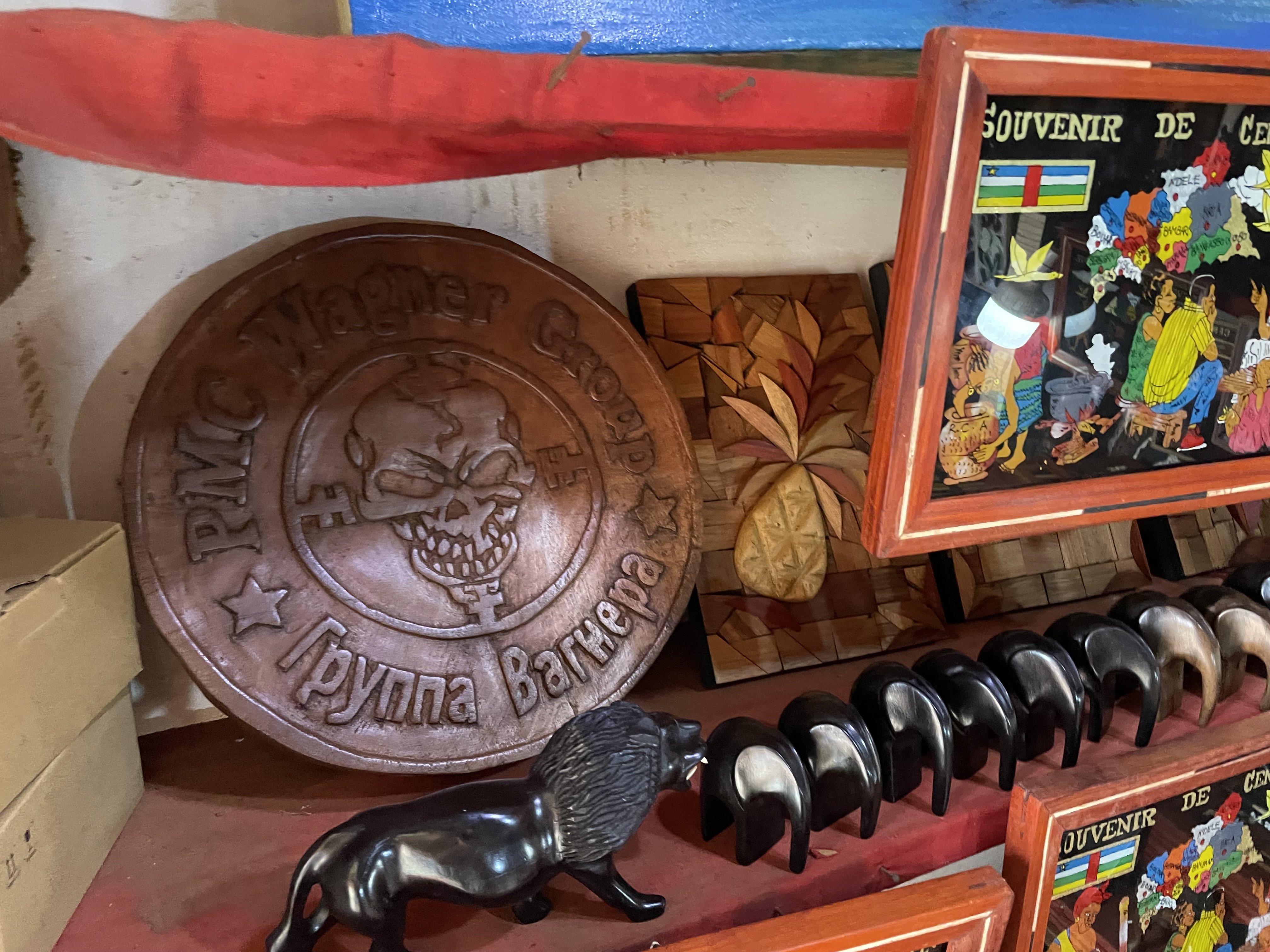
Our next stop was a souvenir market, which had about 15 stalls each run by a different aggressive man. Mostly the same stuff you normally see in other African countries: wooden carvings of giraffes and paintings of the bush. However, there were a few unusual items, most notably a wooden Wagner group carving. This would have been a wild souvenir, but I cannot imagine US Customs and Border Patrol would be happy to see me with merchandise from a recognized terrorist group. Instead, I bought a photo that literally says “Souvenir Centralafrique” for $8. Too funny to not get.
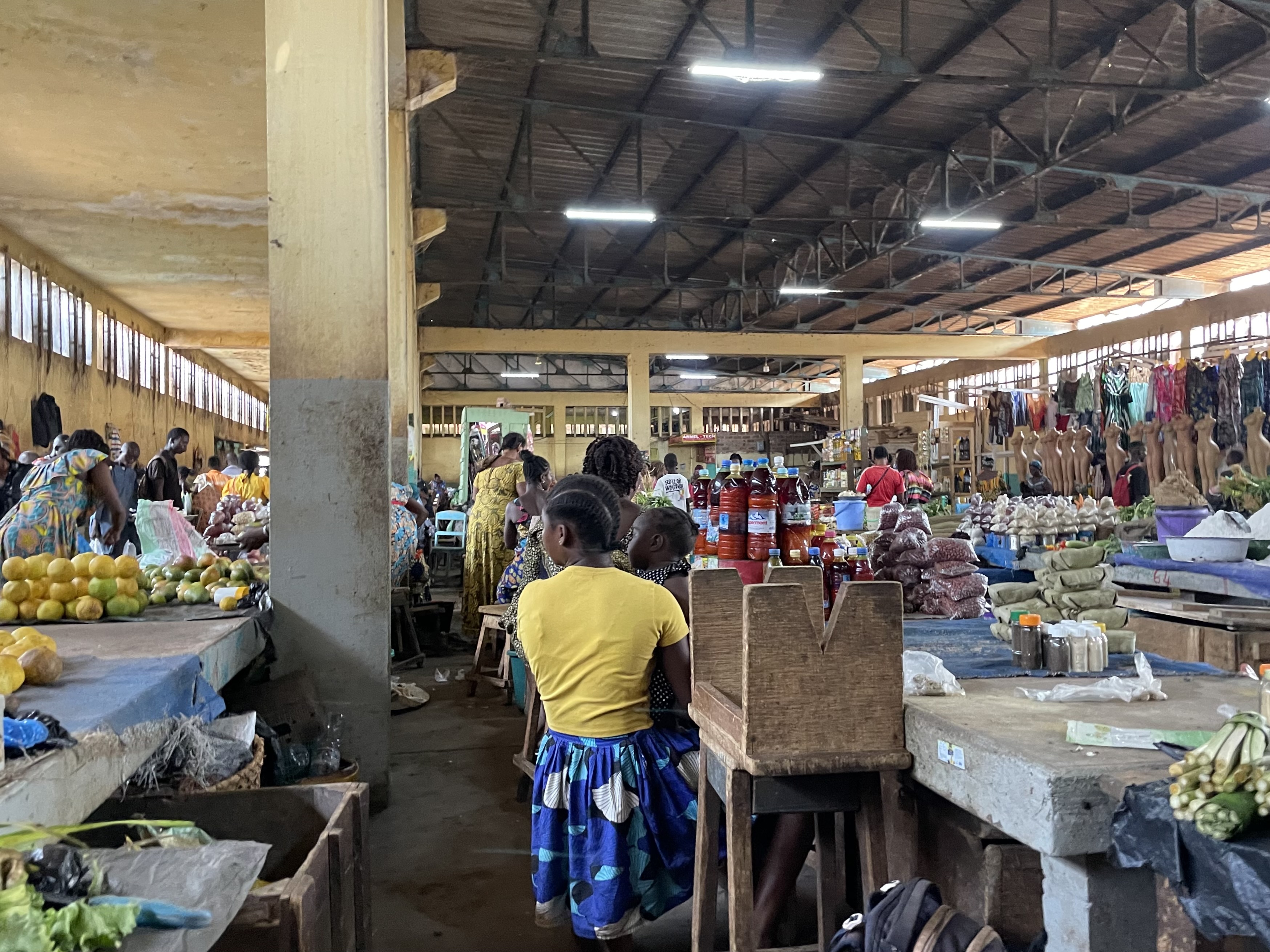
Finally, we visited the normal market. The inner building was mostly produce and some live chickens. The outskirts had clothing and some electronics. The market was busy, and the people mostly didn’t like getting photos taken – except the chicken vendors who asked us to take their photos.
At 11:00, we headed out of town to the Boali waterfall. The drive took about 2 hours. 30 minutes in, we were out of the city. Bangui is relatively small compared to other African capitals without much sprawl. The country has 5 million people, but the capital only has 800,000. Since there really aren’t any other cities in the country (second largest metro area has a population of 80,000), the country is extremely rural.

We passed by some small villages as well as empty land before reaching the Boali Falls visitor center. After paying the entrance fee (covered by Steve but really us indirectly) and ordering at the restaurant, we all walked down to get a glimpse of the falls.
As soon as we started walking down, random young men accompanied us as guides (I did not know if they were official or not). I knew I had to tip them so I did not want their help, but it turns out that the path eventually gets sketchy and I appreciated their help.
At the base of the falls, I changed into my underwear and went for a quick swim (I had a swimsuit packed but was not told there is swimming here).

The mist from the falls was so powerful, I feared my phone was going to become waterlogged like in Cebu on my honeymoon.
Boali Fals were far better than expected. Most African countries seem to have a waterfall. I figured this would be included on the itinerary because there are no other attractions in the country. But no, Boali Falls was awe inspiring. Even the Norwegians were impressed.

As expected, when walking back up, I was asked for a tip. I had 2,000 CFA (about $3) left in cash and gave it to the guide. He was upset and wanted $10 but I think my tip was fair and justified. There was a debate in the car as to whether you should tip these men, as we already paid an entrance fee, and they forced their services on us. I thought that really did add value and helped me get to the bottom of the falls, which is why I tipped.
Back atop the falls, we sat down in the restaurants. There was one other group of young people blasting reggaeton music. I walked over to chat with them. It turns out they are United Nations peacekeeper soldiers on their day off. This group is from a variety of Latin American countries such as Peru, Paraguay and Brazil. Without getting into details, they said that the Central African Republic is extremely dangerous and that a lot of fighting is occurring in the outer regions, but Bangui is safe.
With the group was a single American girl working for a US-based NGO that gets a ton of funding from the US government. She was born in the CAR to Christian missionary parents and took the job so she could return to the land of her birth where she lived for 3 months. Given the major foreign aid cuts by the US government, I am guessing she is quite worried about her job.
For lunch we had grilled fish with plantains and a leafy green vegetable. Everything was delicious!
At around 5pm, we walked over to our van to drive back where we were once again harassed by the “guides” who asked for more money. Our guide, Steve, showed up to shoo them away and we headed back to Bangui.
Back in Bangui, Steve our guide accompanied me back to the Bangui Mall to exchange money- as he needed to also exchange the cash payments for the trip. The cashier took us to the back room of the back room where we met the Lebanese owners of the mall. Out of bags they pulled out stacks of purple 10,000-franc bills. I exchanged $100 USD for 60,000 while Steve exchanged an amount multiple times the country’s GDP per capita. I would have been extremely nervous walking around with that much money.
Steve then organized two taxis who drove the bigger group into the center to a restaurant that served African food (you’d be surprised but very few restaurants in Africa serve local food). While I didn’t experience any issues, the other taxi with some of the ladies on our trip was stopped by the police armed with large guns for not wearing seatbelts (the car didn’t have seatbelts). This was an obvious attempt at extorting a bribe- an unfortunate reality of traveling in sub–Saharan Africa. The officer wanted 15,000 francs ($25 USD). The driver ended up giving 2000 francs (€3) which satisfied the officer. The stop took around 10 minutes.
The restaurant ended up being the meal of the trip. I ordered beef mixed in manioc (an African green vegetable). The restaurant also weirdly played Latin music. Like any restaurant in this type of city, the crowd was full of a mix of both wealthy Africans and the diplomat/NGO class of foreigners. Also the food took about an hour to be served- again par for the course.

The cab ride back was without incident.
March 30, 2025: Bangui
We started today again at 8:30 with a more in-depth tour of Bangui.
Bangui and the Central African Republic have had a very violent history. It has been at war more of less since the country’s independence from France in 1960. There are numerous causes including a Muslim vs Christian divide and a nomadic vs sedentary tribal divide. However, I believe the biggest issue is that there are many different ethnic groups in arbitrarily created borders where only one person/tribe can be the leader.
The most recent civil war started in 2013 when Muslim rebels captured Bangui and took over the government. By early 2014, under pressure from regional leaders, they disbanded and left the capital. However, angry Christian militia groups wanted revenge and started killing/expelling Muslims from the country. By 2015, Bangui’s 120,000 strong Muslim population had been reduced to just 15,000. And those 15,000 were trapped in a single neighborhood where they encircled by Christian militias.
Pope Francis visited Bangui at this juncture in the Civil War. This was his first and only trip to a war zone. He asked both sides to lay down their arms be brothers and somehow it worked.
The Civil War officially ended in 2016 with the election of the former prime minister Faustin-Archange Touadéra (they guy I saw at the airport) to the presidency. However, he and his backers could not maintain control of the country, so he made a deal with the Russian mercenary group the Wagner Group. With an iron fist and a questionable human rights record, they did in fact manage to bring order to the country and stable governmental control of Bangui and the capital region.

The cost was that Russia gained control of the CAR’s mineral resources – specifically diamonds.
We passed by dusty government ministries, United Nations and NGO compounds and roundabouts with monuments to past presidents. None were impressive. In fact, this was probably the ugliest and dustiest capital city I have ever seen. Due to the sensitive nature of the many buildings, there are not many places to safely take photos, but trust me there’s not much to see.
Our first stop of the day was the cathedral: Notre Dame de Bangui, built by the French. The facade was nice but the interior surprisingly bland. The church was packed with people in their Sunday bests. My favorite outfits had a pink religious cloth. I also liked that the bishop personally shook everybody’s hands.

Next, we visited was the Maison Russe (Russian House) a Russian cultural and language center. In front was a statue of the Wagner Group featuring its deceased leaders Yevgeny Prigozhin and Dmitry Utkin. It was truly mind boggling to see this statue for two reasons: 1. The West considers the Wagner Group a terrorist group and 2. The Wagner Group appears to now be held in high esteem by Russia today despite the 2023 events when Wagner briefly turned on Putin in Ukraine – events that suspiciously occurred right before Prigozhin and Utkin were killed in a plane crash.

Along the side of the Maison Russe and right in front of the Russian embassy were murals depicting the friendship of Russian and the CAR.

Another landmark of the city is a Hollywood Sign-knockoff. In smaller font it says “Le coquette” which means pretty/dainty. The joke was during the civil war it should have said “le rocket”.

We also visited a street market


and finally the national mosque where we met the imam who helped negotiate the peace deal.

Having completed our tour, we got lunch and then headed back to the hotel.

A few hours later, a small group of us noticed that the football stadium lights were on and the stands were full. Our guide hinted that the presidential inauguration was going to happen. After walking over, we determined that it was in fact a football match.
The stadium was packed with chanting fans and there were dozens of brigades of armed police and UN peacekeepers.
We got to the stadium more than an hour before the game started and I was very nervous due to the crowd- football fans can get out of control.
Instead of waiting 2 hours for the game to start, we found a barbershop that doubled as a bar. I got a haircut while the other two got a beer. The barber only used a razor but still managed to give me a good cut. The total was 2500 francs or $4.

Back at the hotel, it was the start of Ramadan, Eid al-Fitr. Muslims- mostly younger men were posing for photos with their friends around the hotel pool.
For dinner, the big group all headed to a French restaurant in the center. I got a gratin with ham.
After, we headed to a nightclub to see the scene. This was a large club but still had the typical tables of people drinking beers, strong blue lighting and great music. A few people were dancing.

On the way back, we got stopped by the police who asked to see our passports. I made the rookie move of not bringing it. Luckily, I had photos of both my passport and visa so they let me go.
March 31, 2025: The Longest Journey Home
I made sure to sleep in today because it was about to be a very long journey back.
At 11:00, I left with another group member to the airport while most people stayed an extra day to visit a Pigmy village. I would have love to stay, but I needed to be back for a key work meeting.
The airport experience flowed but still had an unbelievable number of steps. We had at least 15 passport checks plus a yellow fever vaccine check plus immigration and security (which was surprisingly lax). Funnily enough the Chinese delegation was on our flight, so the president was back to send us out. As we pulled away from the gate, I could see him waving.
The other planes on the ground were either UN, Doctors Without Borders or an unmarked Ilyushin II-76, my first time ever seeing this legendary Soviet-designed plane.

The journey back took me to Addis Ababa then to Rome for a refueling stop. After an hour on the ground, we continued to Washington D.C. Finally, I had a 6-hour journey back to LA where my flight attendant shockingly used to be a French diplomat in the CAR. Once back in LA, we hit rush hour, and it was a 2-hour drive home. After working the rest of the day, I immediately fell asleep and slept for 12 hours, waking up refreshed and somehow not jetlagged.
Final Thoughts:
I had a great time, but the Central African Republic is not a place I would recommend.
First, getting the visa requires a lot of work. You need to go through a tour guide who can provide a letter of invitation. There are not many tour guides and very few speak English.
While I thought the sights were interesting, everything in the CAR can be seen in another country. Bangui as a city is whatever. Boali Falls was extremely impressive but there are other African countries with amazing waterfalls. The pigmies, which I did not get to see, do exist in neighboring countries such as Uganda. The UNESCO World Heritage national park in the southwest of the country can also be visited in Republic of Congo or Cameroon. The biggest “novelty” is experiencing a city on the edge of war which is not a good reason to visit a place.
There are so many guns around town – probably more guns than I have seen combined in my entire life. The guns put me on edge, but in reality meant that the city is safe because it is a huge armed standoff. The biggest risk is taking a photo of a soldier or mercenary which could result in a detention or getting shot at. If you can be careful with your camera, then you will most likely be totally safe.
I get why the CAR is one of the last countries people visit: there are similar countries that are so much cheaper, safer, and easier to visit. Perhaps one day, the CAR will become safer and I can visit the rest of the country. Unfortunately, I do not think that day is coming soon.
Regarding the group trip, I am very much not a group trip kind of guy, but CAR was a good place for one. Our days had a lot of downtime (especially at restaurants) and it was fun to chat with likeminded people – I was the least-traveled person on the tour. The downside of the group trip is dealing with different travel styles and quirks, but on this trip, it didn’t make a huge impact since we had so much slack in our itinerary. I felt that Nomadmania as an organizer and operator did a good job. They were less polished than a more established company but were honest and kept costs down. It is impossible for things go 100% right in a country like the CAR and Nomadmania kept us aware of the issues and alerted us as things changed. I would 100% go on another one of their trips.
Leave a Reply